

“We accumulated a lot of great reviews this month, but I bet very few people actually saw them.” This was what the owner of a small workshop in Busan said during a consultation. Customers have always expressed their gratitude—via KakaoTalk messages, text messages, and sometimes Instagram DMs. However, those precious reviews remained only within the recipient’s phone and were never passed on to the next customer.
There were definitely reviews. The problem was the lack of 'management.' There were a few on Naver, a few on Instagram, and dozens scattered across KakaoTalk chats, but none of them caught the eye of new customers. The owner said, "It feels awkward to ask for reviews, and I don't know where or how to use the ones I do receive." They were simply letting the positive feedback slip away without turning it into an asset.
The question asked during the first consultation with Mrs. Lauren was simple: “Have you ever gathered all the reviews you’ve received so far in one place?” The owner replied that she had not. From that moment on, the work began. It involved gathering scattered reviews, establishing a structure to receive new ones, and utilizing them as marketing assets. Over the course of three months, three changes occurred.
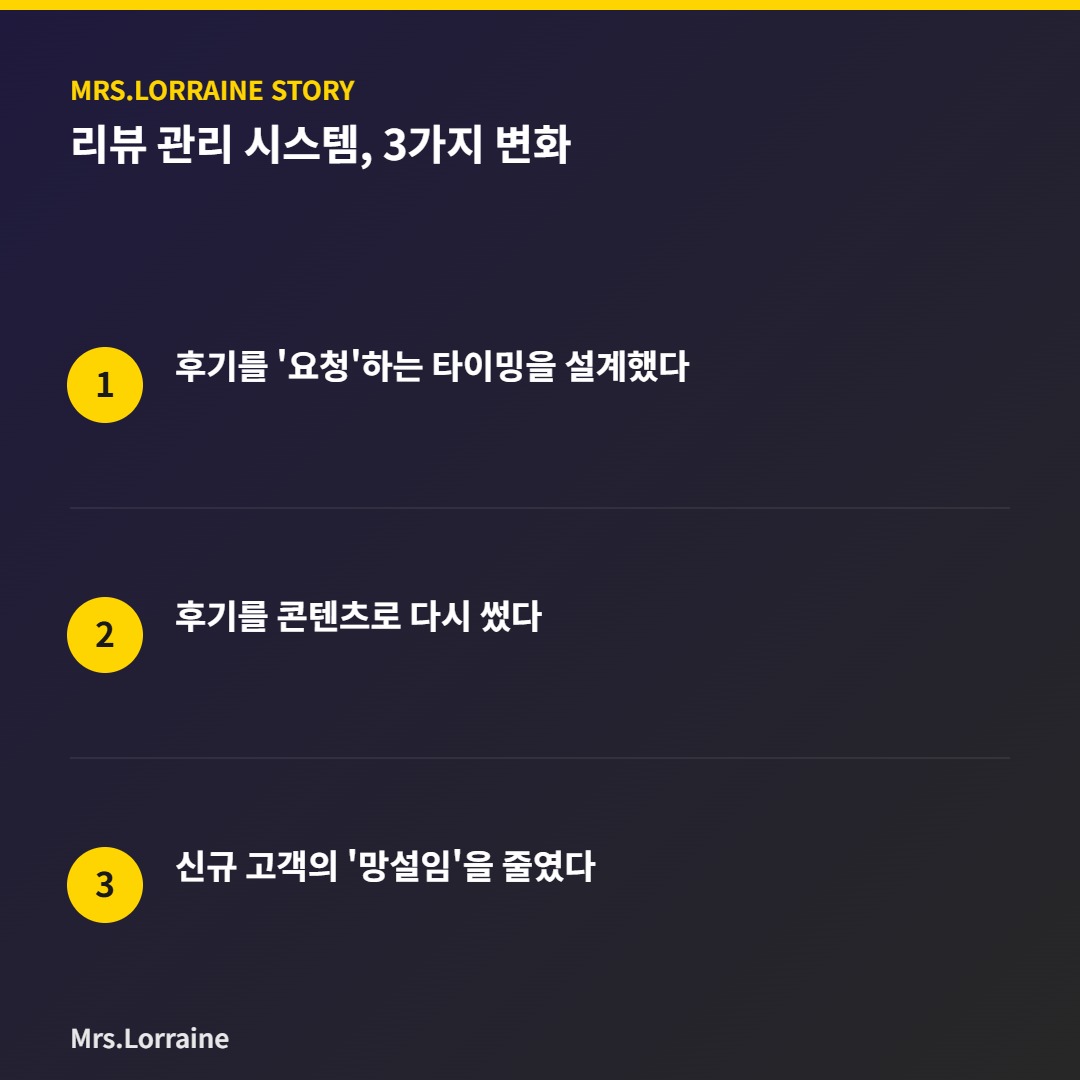
3 changes made with Mrs. Lauren
Change 1. Designed the timing for 'requesting' reviews.
The first thing we changed was 'when we ask.' Previously, we waited only for customers to voluntarily leave reviews, but now we have integrated our KakaoTalk channel with our text messaging system so that a review request message is automatically sent three days after the product is received. We also changed the question format from "How was it?" to something easier to answer, such as "Please tell me just one thing you liked the most.".
The results were immediate. Previously, there were only two or three voluntary reviews per month, but after sending request messages, the response rate increased noticeably. The owner said, “The best thing was not having to beg for reviews.”.
Change 2. Rewrote the reviews as content.
The collected reviews were not left untouched. We selected every single line left by customers and rewrote them as Instagram card news, in the review section of our homepage, and as illustrations in the middle of blog posts. In particular, we gathered frequently mentioned keywords—such as “I liked that the packaging was meticulous” and “It arrived faster than expected”—and reflected them in our product descriptions.
As a single review began to resurface in various places, the owner's workload also decreased. Instead of racking his brains over new promotional phrases every time, he simply had to borrow words that customers had already proven.
Change 3. Reduced new customers' 'hesitation'
The biggest change was conversion. As we organized and displayed real reviews on the product detail pages and the homepage, new inquiries that were hesitant before consultation gradually decreased, and the conversion rate to immediate purchases increased. The owner remarked, "I don't have to explain the same thing to the same questions every time; the reviews speak for me.".
What resonated more than the numbers was the peace of mind. Watching the system where reviews accumulated and automatically brought in the next customers, the owner said, “For the first time, I felt like I didn’t have to struggle alone.”.
Good reviews are often already in the hands of business owners. The only problem was the lack of a 'system' to collect, showcase, and rewrite them. Mrs. Lauren works to fill this small gap together. Rather than grandiose marketing theories, starting with how to properly use what you currently have—that is the beginning we believe in.