

When you start marketing, you are often told that the first thing you need to do is demonstrate "what makes your product different." However, to identify that "difference," you must first be able to look into your competitors. Many small business owners tend to postpone even starting competitor analysis, viewing it as a daunting research report; in fact, competitor analysis is a task that can be fully accomplished on your own simply by following a few questions in sequence.
Why should we look at competitors first?
No matter how closely you examine your store or products, it is difficult to clearly see 'why you should be chosen.' The answer, however, becomes clearer when you compare them side-by-side with competitors. When you look at price, tone, channels, and customer response together, your strengths and weaknesses become visible simultaneously. Therefore, the first step in marketing begins not with looking inward, but with looking outward.
The main reason people feel overwhelmed by competitor analysis is the lack of a standard for 'where to start and what to look at.' The four steps below organize those standards in order; by following them one by one, you will naturally visualize your brand's position.
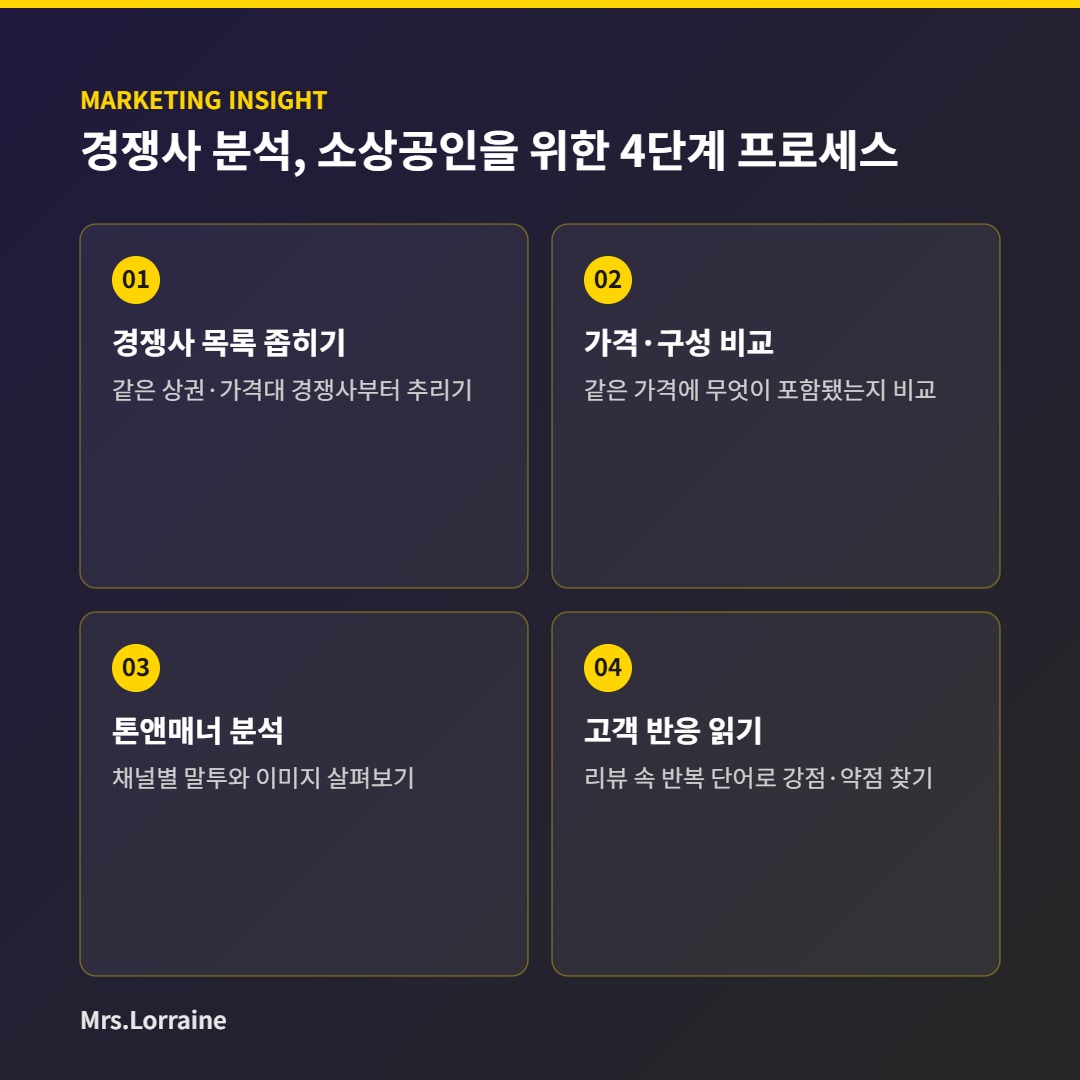
01. Don't look broadly at the competitor list, start narrowing it down
The first thing you need to do is specifically write down 'who you are competing against.' Not everyone in the same industry is a competitor. You must narrow the scope to places that share the same region, similar price range, and customer base for the comparison to be meaningful. For example, if you run a neighborhood cafe, narrowing the list to three or four cafes in the same commercial district is a much more useful analysis than blindly benchmarking famous franchises nationwide.
02. View price and composition side by side by number
The next step is to organize prices and product configurations into a table. You should not simply compare prices; you must also note what is included at the same price and how the option configurations differ. As you organize this information, you will often discover that you were losing out not because the price was high, but because the explanation was 'insufficient.'.
03. Tone and Manner, Channel, and Where and How to Speak
We examine which channels competitors primarily operate on and the tone and image they use to approach customers within those channels. By gathering everything from the color scheme of their Instagram feeds and the writing style of their posts to their frequently used hashtags, it becomes clear which customer the brand is targeting. This is where ideas begin to emerge on how to differentiate your brand's unique tone.
04. Reading the Real Voices in Customer Reactions, Reviews, and Comments
Finally, I carefully read through the reviews and comments of my competitors. More important than the reasons for high or low star ratings are the words customers repeatedly mention. The brand's true strengths and weaknesses lie within frequently appearing phrases, such as "because they were friendly" or "because delivery was late." As I read these voices, the gaps my brand needs to fill naturally begin to emerge.
Comparison is not to shrink back, but to find direction
The purpose of competitor analysis is not to follow others, but to accurately understand your own position. Once you have gone through these four steps, you will be able to articulate "why we are different" much more confidently when writing marketing messages in the future. You do not need to create a perfect report from the start. Beginning with a single note is sufficient.