

Advertising costs are becoming an increasingly burdensome expense for small business owners these days. Costs per click are steadily rising, and the effectiveness is difficult to predict. On the other hand, word-of-mouth marketing spreads based on trust without requiring significant investment, making it a strategy that brands with limited budgets should pay particular attention to. In particular, for small business owners operating physical stores, a single word-of-mouth recommendation often brings in more long-lasting customers than multiple advertisements.
Why Word-of-Mouth Marketing Is Gaining Attention Again
People tend to trust recommendations from acquaintances or trustworthy individuals more than advertisements. As information floods the internet, "who recommended it" has increasingly become the criterion for selection. Word-of-mouth marketing can be described as the process of intentionally designing this flow of trust rather than leaving it to chance.
However, word-of-mouth does not arise automatically simply because a product or service is good. Diffusion only begins when you create both a "reason why customers want to talk about it" and an "easy way to talk about it." The following four methods are ones that even small brands can try right away.
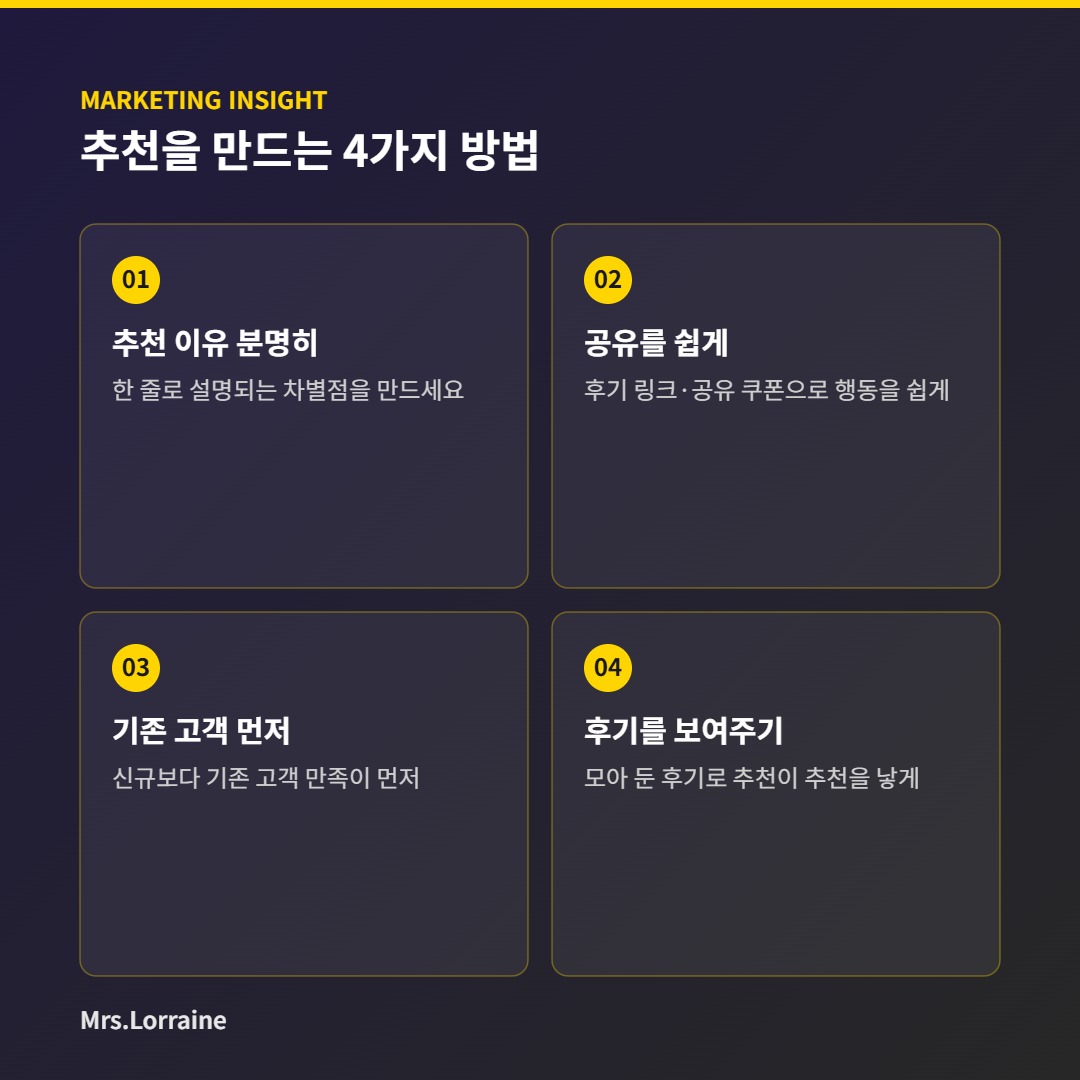
4 Ways to Make Recommendations
First, you must clearly establish a reason to recommend it. It is difficult for customers to talk to others based solely on the impression that it is a "good product." You must have a distinguishing feature that can be summarized in a single line—"This place is different"—so that customers can repeat that exact line.
Second, you must establish mechanisms to make recommendations truly easy. You need to lay the groundwork in advance for "easy paths to action," such as links that make it easy to leave reviews, simple coupons that can be shared with friends, and instructions that are easy to screenshot and send. Even if users have had a good experience, it will not lead to actual action if the recommendation process is cumbersome.
Third, prioritize existing customers over new ones. Recommendations only come when customers who have already experienced the service are satisfied. Rather than pouring budget and attention solely into attracting new customers, conveying small words of thanks or providing additional information to those who have already visited generates more recommendations in the long run.
Fourth, make accumulated recommendations visible again. Gathering reviews and recommendation examples in one place reassures undecided customers and confirms to those who have already recommended that their choice was not wrong. If this process is repeated, it creates a flow where recommendations generate more recommendations.
The four methods are not steps that must be followed in sequence, but rather are akin to interlocking gears. A sharing mechanism only gains meaning if there is a clear reason to recommend it, and collected reviews become persuasive only if existing customers are satisfied. It is better to consistently work on things one by one than to end up unable to start anything by trying to achieve perfection all at once.
It is enough to start small.
Word-of-mouth marketing is not a campaign that produces a huge impact all at once, but a strategy that builds up little by little through daily customer experiences. It is okay not to have all four elements in place at once. It is more important to start by applying the one that is easiest to begin with right now.
If you find it difficult to handle marketing alone, finding a partner to design the overall strategy together is a good option. Mrs. Lauren assists small business owners with their marketing all at once, from planning and production to global promotion.