

“Let’s start by offering a 30% discount.” When sales slow down, the first method small business owners think of is a discount promotion.
The effect is immediate, but any business owner who has experienced sales plummeting the day after a discount ends will understand. Discounts boost short-term sales, but if used incorrectly, they end up leaving behind nothing but the image that "this brand pretends to be expensive only when there is a sale.".
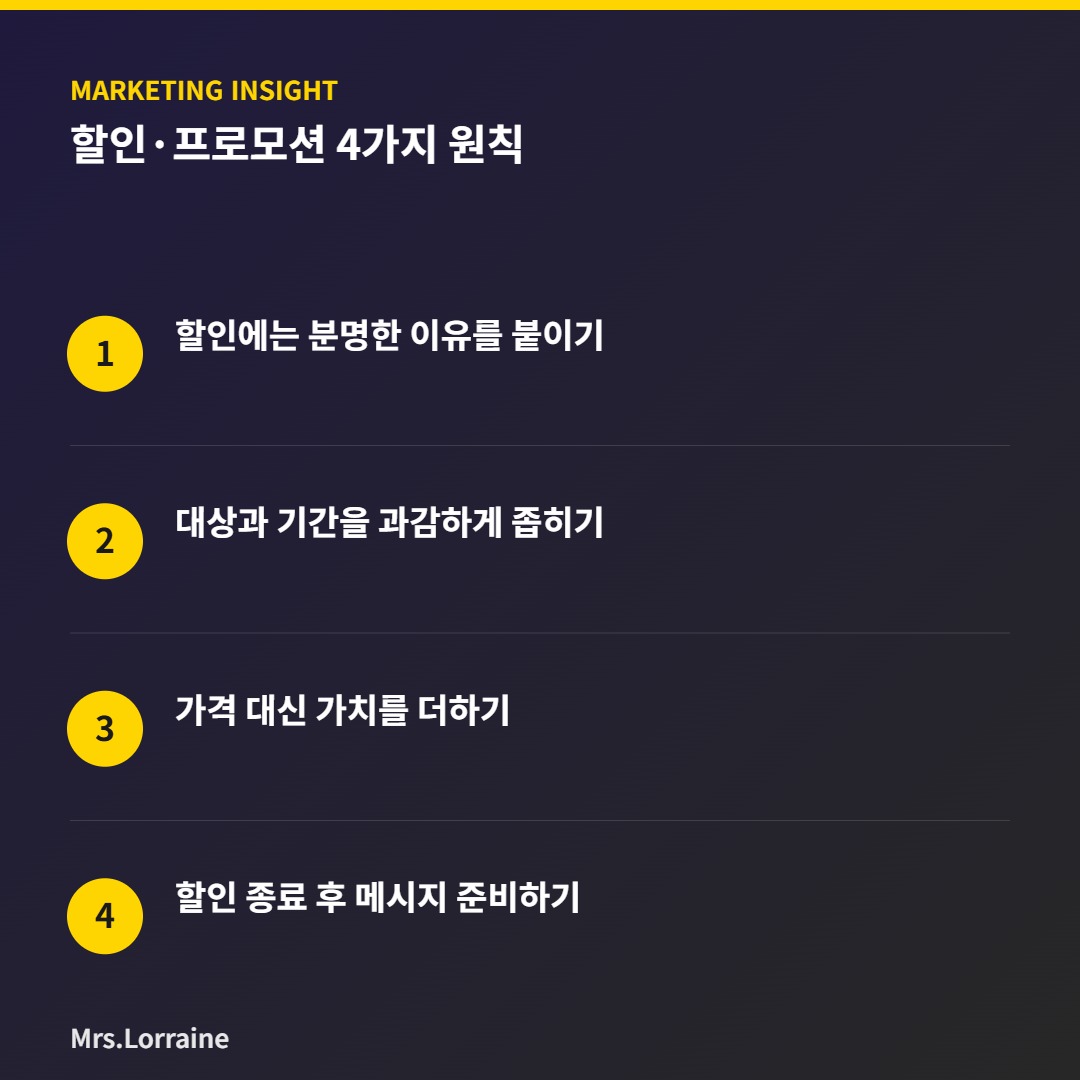
The problem is not the discount itself, but the way it is used 'out of habit.' If you frequently discount all products for all customers without a special reason, customers who buy at the regular price will feel like they are losing out, and only customers who respond solely to price will remain. Therefore, even when using discounts, it is best to adhere to at least four principles.
Principle 1. Attach a clear 'reason' to discounts
“Instead of simply saying ”it’s just a sale,“ you must convey a reason that resonates with customers, such as ”to celebrate our 3rd anniversary“ or ”because it’s clearance stock from this season.“ Discounts with a reason become a brand narrative, whereas discounts without a reason leave nothing but the numbers on the price tag. For example, the owner of a home decor shop removed the ”Total 101 TP 3T Discount“ sign, which they had habitually displayed every month, and instead started holding a sale twice a year during the ”week of the changing seasons“ under the name ”Clearing-out Sale to Prepare for the Next Season.” Although the frequency of sales decreased, customers reportedly began looking forward to that time.
Principle 2. Drastically narrow the scope and timeframe
Instead of offering long-term discounts on all products, you should narrow your target audience to specific items or new customers and set a short duration. For example, say, “From this Friday to Sunday, only 3 new products.” The narrower the scope, the more customers feel a sense of “if not now, I will miss out,” and business owners can minimize the number of products that jeopardize their profit margins. Many small business owners actually experience that narrow, short-term discounts have higher conversion rates than wide, long-term ones.
Principle 3. Adding Value Instead of Lowering the Price
If you are unsure, changing the product composition instead of the price is a viable option. This involves offering a larger size at the same price, buying two for free, or adding a small free gift. Since the regular price remains unchanged, the brand's price credibility is preserved, while the perceived value for customers clearly increases. A cafe owner who consulted with Mrs. Lauren created a limited-edition "drink + dessert set" instead of discounting Americanos, and as a result, actually increased the average transaction value.
Principle 4. Prepare a message for after the discount ends in advance.
You should also decide in advance what to say once the discount period ends. It is important to maintain a consistent message to ensure the relationship with customers is not severed even after the price returns to the regular level, such as by saying, “The discount is over, but we thank everyone who chose this product.” If you quietly bury the end of the discount, customers are likely to feel “deceived,” but if you conclude the matter politely, they will trust and look forward to the next discount.
Ultimately, discounts are merely one of many tools to boost sales; they cannot be the strategy itself that sustains a brand. By adhering to four principles, you can preserve your brand value even while offering discounts. Mrs. Lauren works together with small business owners to help them establish clear reasons and strategies behind the numbers, rather than simply choosing to "cut prices first and see what happens.".