

Last month, a customer living in Australia sent an inquiry via Instagram DM. “Can I order these handmade candles from overseas?” The owner, who was excitedly replying, stopped at the payment stage. This was because the payment methods linked to the website only supported domestic cards. Eventually, the customer switched to another brand, and only then did the owner realize that they were “completely unprepared to accept global customers.”.
This was not a one-time occurrence. We received a steady stream of inquiries from the U.S., Japan, and Singapore, but the conversations ceased the moment payments were blocked. The owner requested help from Mrs. Lauren, stating, "I can manage to reply in English using a translation app, but I cannot handle the payments." It was a common dilemma faced by those struggling with marketing: "Sales missed due to a lack of a system, despite interest.".
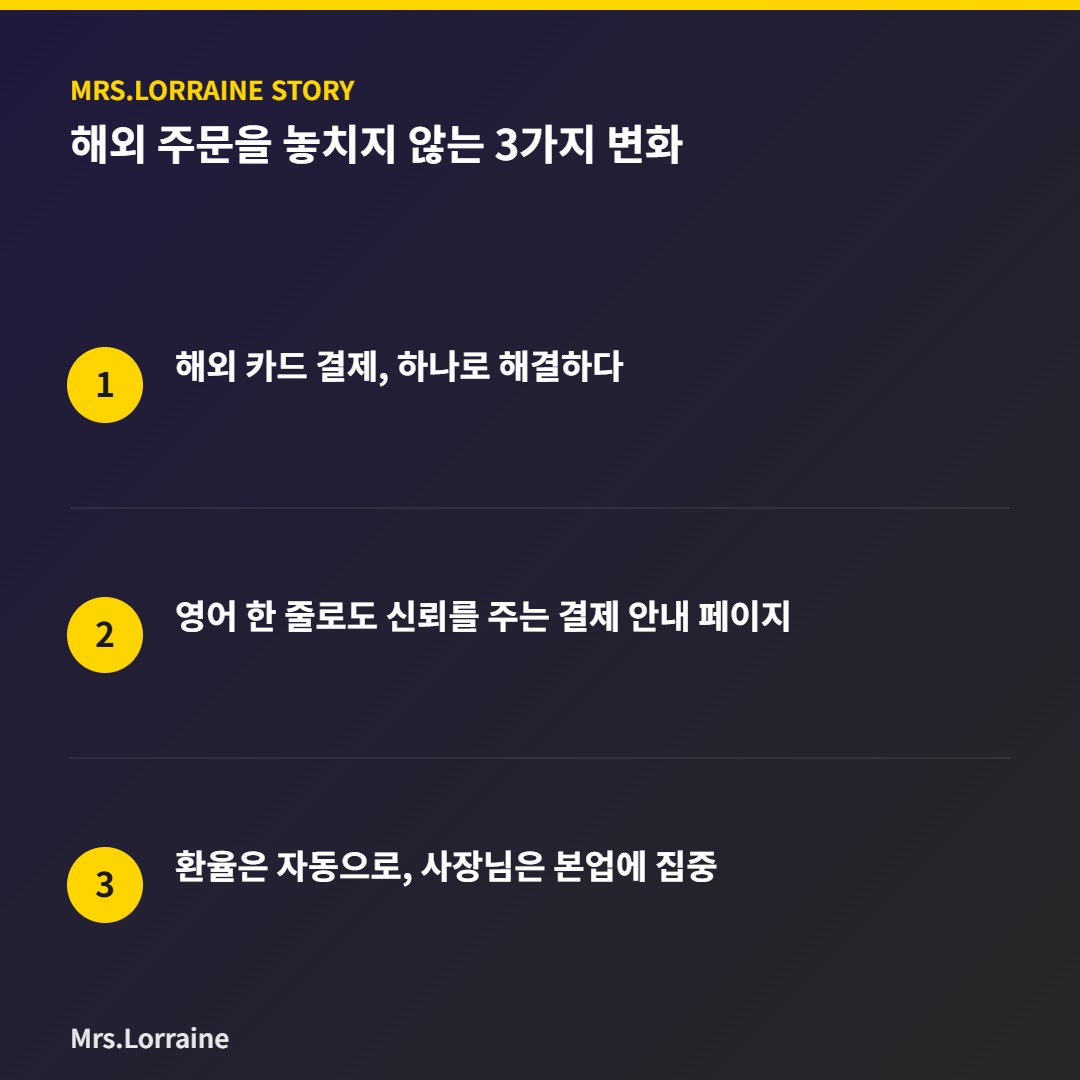
Change 1. Solve all your international card payments with a single solution
The first thing we did was integrate a payment gateway into the website to accept international card payments. We established a system capable of accepting Visa and Mastercard payments in just one day, without the need for complex merchant agreements or separate overseas subsidiaries. The CEO expressed his amazement, saying, "It was such a simple task; why did I think it was impossible all this time?".
Later, when the Australian customer sent another inquiry, the owner was able to resolve the matter by simply sending a payment link. That customer has since made three more repurchases and has become a loyal fan who tags and introduces the product on their social media.
Change 2. A payment guide page that inspires trust with just a single line of English
Having payment methods alone was not enough. International customers easily abandon pages that explain shipping times, customs duties, and exchange/refund policies only in Korean. Mrs. Lauren also created a short and clear English guide page containing only essential information. Rather than the elegant sentences of a professional translator, we opted for a practical layout that immediately answers the questions customers might have before clicking the payment button.
The CEO said, “I used to think that you needed to be fluent in English to do global marketing, but I realized that you only need to prepare the exact sentences you need.” With just this single short page, the time spent responding to inquiries from overseas customers decreased noticeably.
Change 3. Exchange rates are automatic, allowing the owner to focus on core business
Searching for exchange rates and calculating prices every time was a significant burden for the owner. Mrs. Lauren integrated a real-time automatic exchange rate reflection feature into the payment system, allowing customers to immediately check prices and make payments in their local currency. This eliminated the need for the owner to manually use a calculator.
Thanks to this small automation, the owner was able to reallocate the time previously spent on payment inquiries to product development and customer service. I was impressed by the remark, “Since the system handles everything, I only have to focus on talking with customers.”.
After undergoing three changes, the CEO's share of overseas sales increased significantly. The most significant change, above all, was that the worry of "what if overseas inquiries come in?" turned into the expectation of "it would be great if overseas inquiries came in." Rather than grandiose global strategies, Mrs. Lauren starts by working together to capture that one order currently being missed. If marketing and overseas expansion feel daunting, let's build it together warmly, starting with something as simple as a payment link.