

These days, Mrs. Lauren is making some special preparations. We have been able to launch a marketing partnership with an internal medicine clinic in the neighborhood that has been seeing patients for a long time. In this clinic's waiting room, you don't hear only Korean. Neighbors from various countries who live, study, and work nearby wait for their appointments together. Although we haven't taken our first step yet, that is precisely why I intend to write about my current concerns with even greater honesty. This is not a post to boast about results, but rather a look straight into the mind of a marketer just starting out.
Mrs. Lauren has helped Korean brands connect with the world. However, this time, the world is already in our neighborhood. It is about reaching out not across the ocean, but to neighbors living in the same alley, in their own language. Lately, I have come to realize that while physical distance may be close, the distance in language and culture is by no means short.
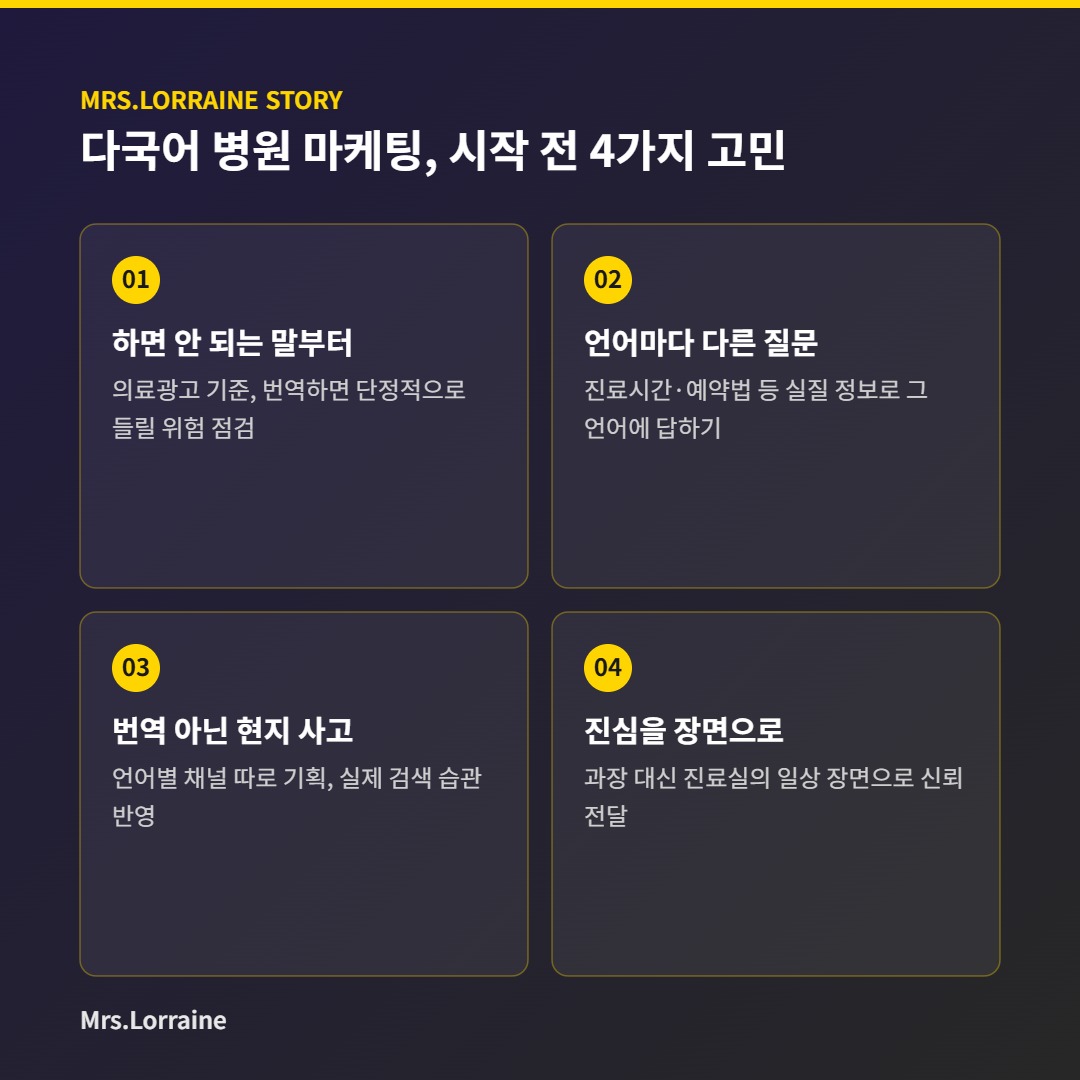
Concern 1. You must learn what not to say before you learn what to say.
In other industries, you can attract attention with words like "most," "best," or "guaranteed." Hospitals are different. Medical advertising has standards that must be adhered to, and expressions that assert treatment effectiveness or compare the hospital to others cannot be used. When communicating in multiple languages, there is one more factor to consider. Even sentences written carefully in Korean can sound definitive the moment they are translated. Therefore, we decided to ask ourselves separately for each language: "Could this word mislead a patient?" It is essentially starting over from the practice of writing precise sentences instead of flowery ones.
Concern 2. The search questions differ depending on the language.
When people are feeling unwell, they do not look for advertisements. Instead, they search for answers in the language they are familiar with. While someone in Korean might ask, "Which department should I see for these symptoms?", a neighbor living in a foreign country will start by asking, "Can I receive treatment in English?", "Is it okay even without insurance?", and "How do I make an appointment?" Therefore, the content we need to create should not be promotional material, but rather kind answers to those questions. I believe that trust begins with accurately providing seemingly trivial information—such as clinic hours, directions, and details to keep in mind for a first visit—in their own language.
Problem 3. Thinking in the language from the beginning, rather than translating.
The easiest method is to translate the Korean text directly. However, such text feels somewhat awkward, and, more importantly, differs from the words people actually use. What Mrs. Lauren learned while managing global channels is that even the same story must be different starting from the very first sentence depending on the language. That is why we plan to organize separate channels for the Korean language and other languages once again. We will examine everything step-by-step, from the maps and reviews that locals actually use to the search habits prevalent in each language region. The direction is singular: to tell stories in the language of the viewers, in the places they visit.
Concern 4. How can I convey the Director's sincerity without exaggeration?
What lingered the longest from our first meeting was the Director's attitude of treating patients equally, regardless of nationality. However, it is difficult to put this sincerity into writing. If we apply even a little force, it becomes an exaggeration, and if we leave it at that, the writing becomes meaningless. Therefore, instead of embellishing words, we intend to show you scenes. We believe that if we accumulate everyday moments—such as the explanations given in the consultation room or the questions first-time patients ask most frequently—the message will be conveyed in any language, without the need to explicitly write "a trustworthy hospital.".
The reason I record my starting mindset
To be honest, I do not yet know the answer. However, one thing is clear: marketing should not be about making the hospital look bigger, but about helping those in need open their doors without hesitation, regardless of where they come from. This writing is a record I leave behind to ensure I do not forget that commitment.
Are you finding that the number of customers speaking other languages is increasing at your store or company? If you are at a loss as to how to approach them, please feel free to talk with Mrs. Lauren.